Why AI-Written Code Is Shaped Like the Happy Path
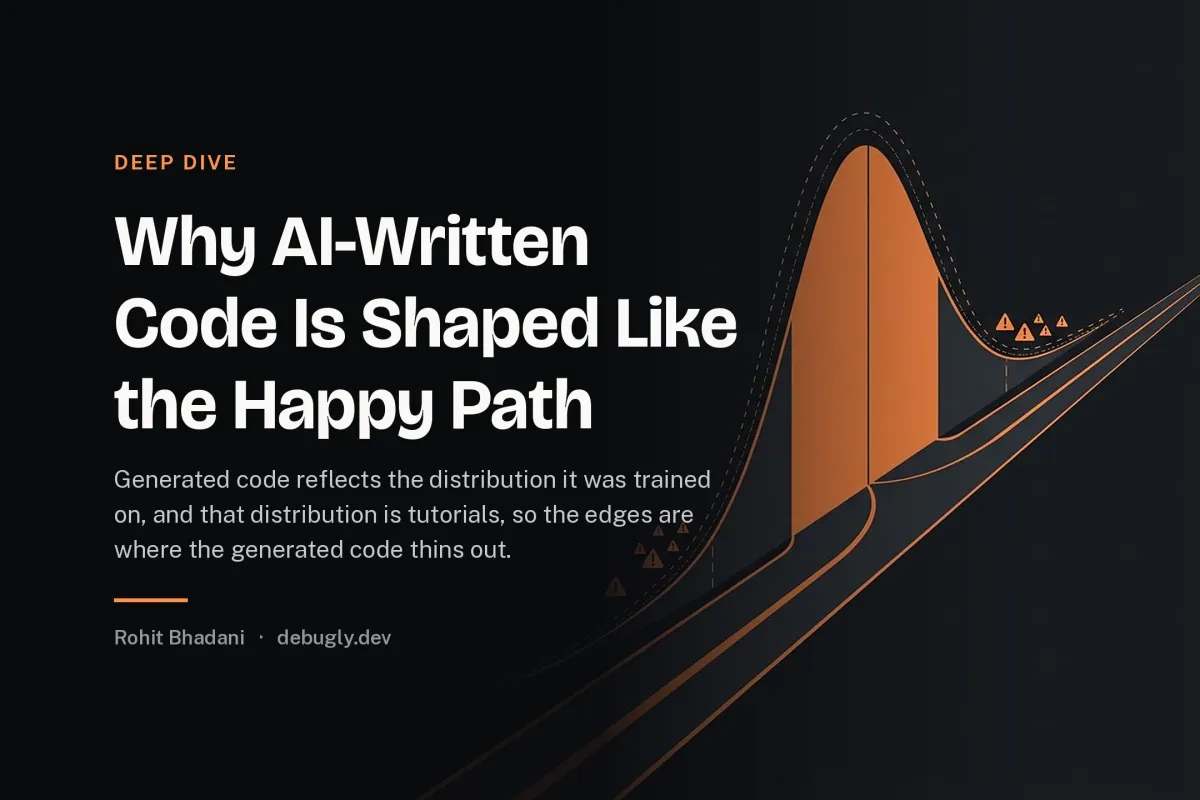
Generated code reflects the distribution it was trained on, and that distribution is tutorials and working examples, so the edges are where generated code…

Between the path that works and the reason the edges fail sit 2 quiet assumptions, and the incident is the story of one of them failing.
Strip the distribution shape down and one property makes it actionable: the shape is predictable, because the distribution is knowable, and the knowable distribution means the thin regions can be named in advance, and the named regions are the review checklist, and the checklist is the fix.
This applies to any model generating code, and the mechanism is the training distribution, which is the same regardless of the model.
The distribution is tutorials
The code the model learned from is the code that exists publicly, and the code that exists publicly is the code people published, and the code people published is the code that worked, and the code that worked is the code that handles the case the author had, and the case the author had is the normal case, because the normal case is the reason the code was written, and the edge cases are handled in the code that was revised, and the revisions are less published than the originals, and the originals are the tutorials, and the tutorials are the distribution, and the distribution is the shape.
The shape is therefore a distribution weighted toward the middle, where the inputs are valid, the resources are available, the network is up, the file exists, the parse succeeds, and the count is positive, and the edges, the empty input, the null, the timeout, the zero, the overflow, the concurrent write, are underrepresented, because they are the cases that do not appear in the demonstration, and the demonstration is what the model reproduces, and the reproduction is the generated code, and the generated code is the middle, and the middle is the happy path.
The model is not choosing to ignore the edges. The edges are thin in the distribution, and the model reproduces the distribution faithfully, and the faithfulness is the problem, because a faithful reproduction of a distribution that omits the edges is code that omits the edges. The omission is invisible, because the tests are generated from the same distribution, so they test the middle too, and the tested middle is green, and the green is the false signal.
Why the edges are where production lives
The production inputs are not the middle, because the middle is the case the author anticipated, and the production traffic includes the cases nobody anticipated, and the unanticipated cases are the edges, and the edges are where the failures concentrate. The edges are a small fraction of the inputs and a large fraction of the incidents, and that asymmetry is what makes the shape expensive: the thin region of the distribution is the dense region of the failures.
This is the same asymmetry as the AI-suggested rounding that broke money, and the common root is the property, not the platform.
The predictable thin regions
The shape is knowable, and the knowable shape gives the checklist, and the checklist is the regions that are thin in tutorials and dense in production:
Empty and null. The generated code handles the populated collection and the present value, and the empty and the null are the thin cases, because the tutorial has data, and the production has the empty result and the missing field, and the missing field is the KeyError, and the KeyError is the incident.
Zero and negative. The generated code divides, and the division is by a count, and the count is assumed positive, and the zero is the division by zero, and the negative is the logic that assumed positive, and the assumption is the shape, and the zero is the edge.
Boundaries. The generated code handles the middle of the range, and the boundary, the first, the last, the maximum, the off by one, is the thin case, because the tutorial uses a comfortable range, and the production uses the exact boundary, and the boundary is where the off by one lives, and the off by one is the incident.
Failure paths. The generated code handles the success, and the failure, the timeout, the refused connection, the partial response, the malformed input, is the thin case, because the tutorial's network works, and the production's network does not always work, and the not always is the incident.
Concurrency and scale. The generated code is single threaded and loads everything, because the tutorial is single threaded and its dataset is small, so the concurrent access is the race that does not reproduce, and the large dataset is the memory that does not fit.
The fixes
Review against the thin regions. The review's checklist is the list above, and the list is the questions the generated code does not answer, and the questions are the review's work, and the work is the fix, because the review is the only place the edges can be added, since the generation will not add them, and the not adding is the shape.
Test the edges explicitly. The test suite's job is the regions the distribution omits, and the explicit edge tests are the compensation, and the compensation is the coverage the distribution lacks, and the coverage is the regression guard, and the guard is the prevention, because the edge test fails on the generated code and the failure is the signal the distribution suppressed.
Ask the model for the edges, and generate adversarial inputs. The prompt that asks for the edge cases produces the edge handling, because the request moves the edges into the specification, and the specification is what the model optimises for. The asking is the cheapest control in this list, one sentence, and the sentence is the difference between the middle and the edges.
The takeaway
Generated code reproduces the training distribution, and the distribution is weighted toward working examples, so the edges are thin, and the thin regions are predictable: empty, null, zero, boundaries, failure paths, concurrency, scale. Review against the thin regions, test the edges explicitly, ask the model for them, and generate adversarial inputs.
The generated code was correct on every input anyone thought to try, and the input that broke it was the one nobody thought to try, because nobody thinks to try the edge, and the edge is where the production traffic goes. The lesson I keep is the property, not the incident.
Published on debugly.dev by Rohit Bhadani | Founder of Krova Cloud