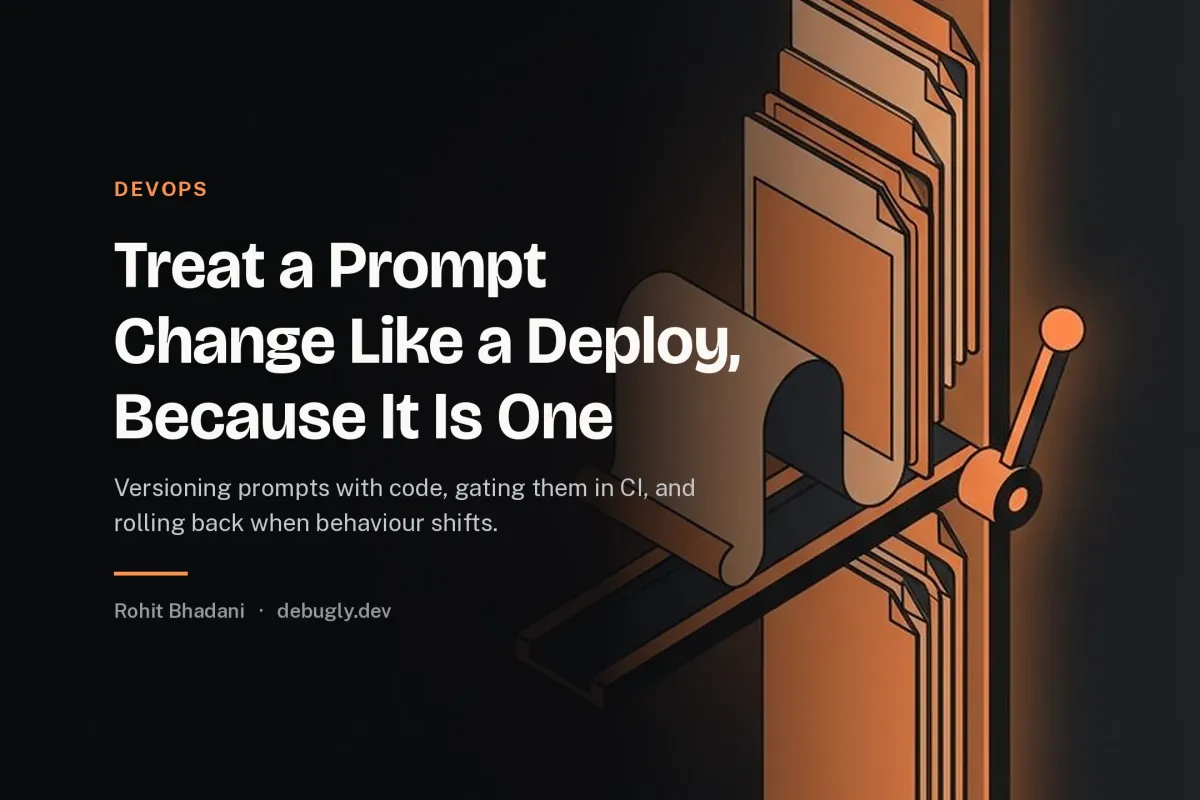
Treat a Prompt Change Like a Deploy, Because It Is One

The regressions arrived as a vague complaint that the assistant "sounds different and gets the policy wrong", and the team's first discovery was that there was nothing to roll back, because the prompt lived as a string in a config file, edited directly, deployed with everything else, and unversioned. The second discovery was that the change had gone to a hundred percent of users instantly, because a prompt has no rollout concept unless you build one. The prompt is the highest leverage line in the system, and it had the weakest change control.
This is the argument and the mechanics for treating a prompt change as a deploy: versioned, reviewed, gated, observable and reversible.
This was a Node 22.14 service with the prompt in an environment string, and the redesign below is what replaced it.
Why a prompt is a deploy
A deploy is a change to production behaviour shipped without a code review of its effects, and a prompt edit is exactly that, with two aggravations. The change is semantic, altering behaviour across every input, not a local fix, so its blast radius is the whole surface. And the change is not checked by the compiler or the type system, because natural language has neither, so the only safety net is the process, which is the argument for giving it the full process.
The mental shift is to stop classifying the prompt as content and start classifying it as code that executes in production, which it is. Once classified, every deploy practice applies without modification.
Version it like code
The prompt moves out of the environment string into a file in the repository, with a version identifier, and the application loads the prompt by version and logs the version per request, which is the tracing field from tracing an LLM pipeline with the observability you already have. Now a behaviour change is joinable to a version, a regression is datable, and a rollback has a target, which are the three properties the Friday edit lacked.
The version id is also the unit of the eval harness: evals run against a version, and the score attaches to the version, so the pipeline can compare versions numerically instead of anecdotally.
Gate it in CI
The pull request for a prompt change runs the eval suite against the new version and the current one, and reports the delta as a check, the same way a performance budget fails a build in a performance budget that survives contact with a real store. The eval delta is the prompt's test suite, and a change that moves a core case red does not merge, which is the review the string edit never had.
CI also runs the diff through the cheap mechanical checks: no accidental removal of a safety instruction, no unversioned variable reference, and a rendered length bound, because a prompt that grew fifty percent is a latency and cost regression, visible pre merge.
Roll it out like traffic
A prompt that goes to a hundred percent instantly is a deploy without a canary, and the canary discipline from a canary deployment that shipped a broken release anyway applies with one adaptation: the canary metric for a prompt is not error rate, it is the eval score on live sampled traffic plus the business metrics, because prompts rarely raise errors, they raise wrong answers, which are silent. So the rollout watches the sampled eval score and the complaint rate, and holds at each step until the numbers are stable.
The feature flag machinery you already have is the rollout mechanism, with the prompt version as the flag value, which is the flag discipline from the feature flag I flipped three hours before anyone noticed, promoted from booleans to versions.
Make rollback a non event
Rollback is the property that makes the whole pipeline cheap, and it must be a config change, not a code deploy. Because the application loads prompts by version and the versions are immutable in the repository, rollback is pointing the flag back at the previous version, which takes a minute and touches no code, and the tracing join confirms within the hour that the score returned. A rollback that requires a deploy is a rollback that will be delayed, and delay is the cost of an incident.
The immutability matters: versions are never edited, only superseded, so the rollback target is guaranteed to be the thing you tested, which is the same guarantee that makes binary artefacts rollback safe, applied to text.
The human in the loop stays
The pipeline does not remove judgement, it relocates it. The eval delta tells you what changed numerically, but a prompt change is a product decision about tone, policy and behaviour, and someone with product authority reviews the rendered diff of the prompt itself, reading it as a specification, because it is one. The review asks the ownership question from AI wrote it so nobody owns it: who owns this behavioural change, and can they narrate the boundary cases the prompt now handles differently.
The rule
A prompt is code that executes in production with the widest blast radius and the fewest automatic checks, so it gets the pipeline code gets: versioned and logged, gated by an eval delta in CI, rolled out behind a flag with live score watches, and rolled back by a config change to an immutable version.
The Friday string edit was not lazy engineering, it was the default. The pipeline is the decision to stop defaulting, and the decision pays for itself the first time a regression is a one minute rollback instead of a week of "sounds different".
It also changes the on call experience, which is where the payoff is felt first. With versions logged and rollback a flag, the two in the morning page about a behaviour shift becomes a one minute revert and a morning analysis, instead of a forensic dig through an unversioned string. The pipeline buys back the night, and it buys it with the same machinery your code deploys already use, applied to the one file that changes behaviour more than any other.