CVE-2026-21589: The Double Colon That Became a Slash
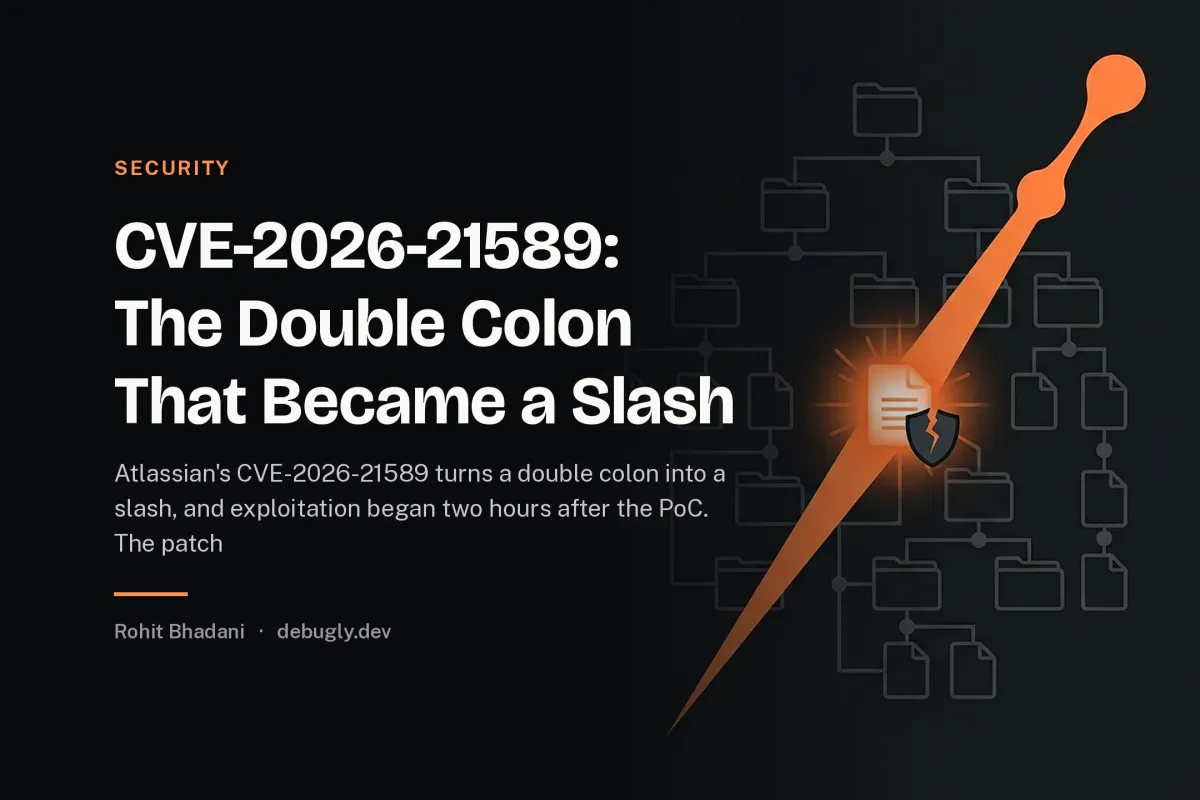
Atlassian's CVE-2026-21589 turns a double colon into a slash, and exploitation began two hours after the PoC. The patch window is now measured in hours.

Start at the colon and you miss it. Start at the admin and you miss how it arrived. The bug lived in the hand-off.
CVE-2026-21589 is the Atlassian Data Center flaw disclosed on 5 October, rated 9.3, and it is worth your attention this week for two reasons. The root cause is a string conversion that most engineers would read as harmless, and the exploitation started about two hours after the technical details went public. Both halves of that sentence are the story.
The facts below come from Atlassian's advisory, watchTowr's technical write-up, and Previdian's honeypot telemetry as reported by The Hacker News and BleepingComputer between 6 and 9 October.
What the bug actually is
The flaw affects eight self-hosted Data Center products: Bitbucket, Confluence, Jira Service Management, Jira Software, Bamboo, Crowd, Crucible and Fisheye. It is an arbitrary file access inside the web application root. It does not list directories, and it only reads a file whose exact name and path the attacker already knows, which sounds reassuring until you remember how many file names are completely predictable.
watchTowr's report traces the root cause to a shared web-resource library that converts double colons into slashes, so a string like ..::..::..::..::WEB-INF::web.xml becomes ../../../../WEB-INF/web.xml. Feed that through a plugin resource endpoint such as the colorpicker images path, add the trailing slash that the endpoint expects, and the path resolution walks up out of the plugin directory and into the application's own files. A conversion written to make resource keys portable became a directory traversal, because the input was allowed to choose where the conversion happened.
In deployments where Jira or Confluence trusts a Crowd instance for single sign on, the prize gets bigger. WEB-INF/classes/crowd.properties holds Crowd credentials in plaintext, and with those an attacker can talk to Crowd's API, create a user, and promote it to Jira administrator. A file read became a full takeover without a single login.
Two hours is the patch window now
Previdian says its honeypots saw exploitation attempts from three IP addresses, in Japan and the United States, roughly two hours after watchTowr published, fifteen attempts in the first window. A Nuclei template now exists, which means the scanning stops being bespoke and becomes a loop anyone can run. Atlassian's fixes are available per product, and its suggested mitigations include pulling the instance off the public internet, a WAF rule, Tomcat's RewriteValve for the Confluence, Jira, Bamboo and Crowd family, and a urlrewrite.xml rule for Bitbucket.
The uncomfortable part for anyone running these boxes is that the disclosure and the weapon were effectively the same event. The advisory went out on 5 October, the deep technical details and PoC around 7 October, and the scanners arrived the same day. If your upgrade process takes a change-approval cycle, your cycle is now longer than the attacker's tooling pipeline, which is the same lesson as the OAuth flow that broke on a trailing slash: the string handling at the edge is where the trust lives.
The conversion was somebody's feature
It is tempting to read the double colon conversion as a mistake, and it is more useful to read it as a feature that lived in the wrong neighbourhood. Resource keys that travel through URLs and templates need a portable alphabet, and mapping a separator to a path segment is exactly the kind of convenience a shared library accumulates so that a hundred call sites never think about it. The bug is not that the conversion exists. It is that the conversion ran on input an attacker could choose, on the way to a filesystem boundary, with a trailing slash waiting to complete the sentence.
That framing gives you an audit list instead of a scare. Every place your code translates one alphabet into another before touching a path, a credential store or a query, double colons, dot dot sequences, percent signs, backslashes, unicode normalisation, is a place where the input picks the destination. It is the server side of the JSON parse that became a prototype pollution, where a structure that meant data to the sender meant code to the receiver.
And the week itself is a data point. In the same few days, a NetScaler zero-day that knocks SAML deployments offline and an Ahsay backup chain deploying webshells were both in active exploitation, so a team triaging on severity alone would have patched in the wrong order. The order that works is exploitability first: what is public, what is being scanned, what is reachable without a login.
What I would check this week
Patch to the fixed versions first; the mitigations are for the boxes you cannot restart today. Then hunt, because the exploit leaves readable traces: access log lines containing the double-colon pattern or the colorpicker images path followed by an unexpected file, any new user appearing in Crowd or Jira admin rosters, and Crowd API calls that create or modify users from addresses you do not recognise. The plaintext credentials file is the pivot, so treat any read of it as a compromise, not a curiosity.
The broader pattern is that input which chooses its own conversion is input that chooses its own path. It is the same family as the path parameter that was never URL encoded, which is why the two fixes look alike.
The takeaway
Every string conversion between an external input and a file, path or credential boundary is a security surface, and the time between a public PoC and mass scanning is now measured in hours, so patch cycles that assume days are unpatched windows. Read your access logs for the conversion pattern, not just the destination, and assume any plaintext credential file that was readable was read.
Atlassian's CVE-2026-21589 is a double colon becoming a slash, a predictable file name doing the rest, and a two hour head start for the scanners, which is exactly the combination that turns a 9.3 on paper into a roster of rogue administrators in practice.