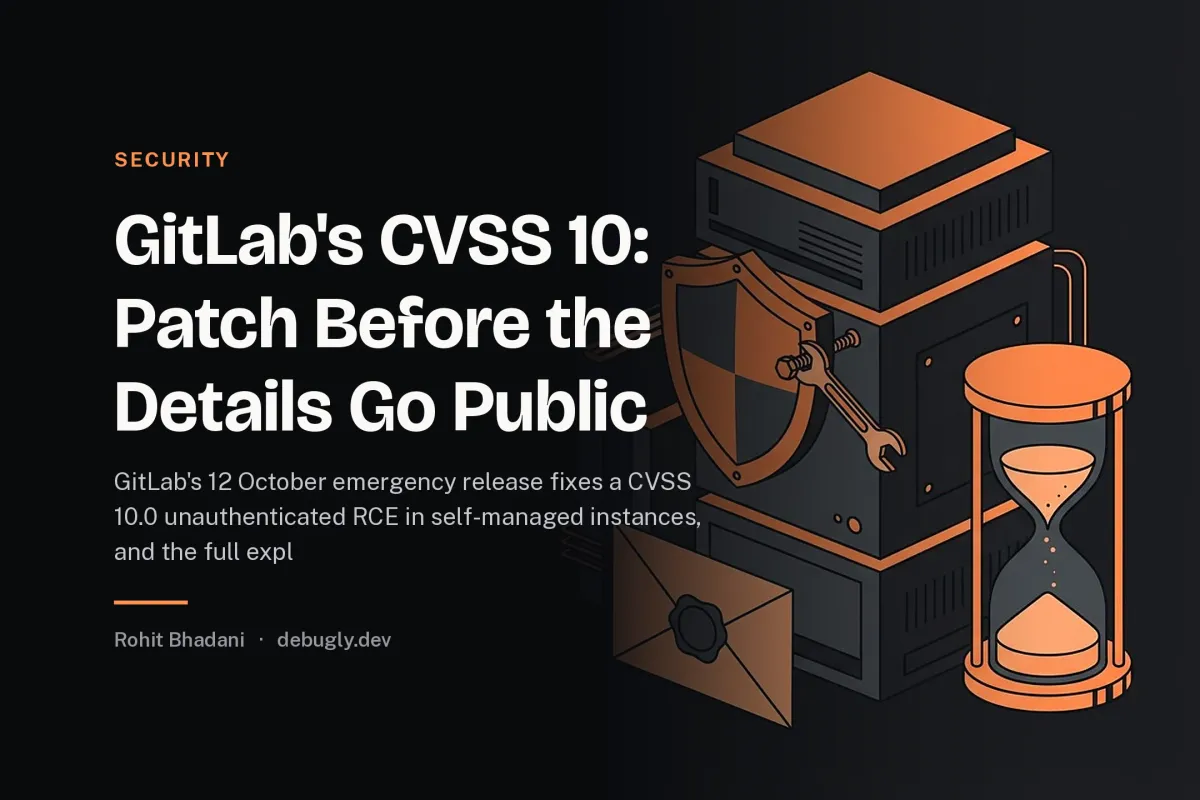
GitLab's CVSS 10: Patch Before the Details Go Public
GitLab's 12 October emergency release fixes a CVSS 10.0 unauthenticated RCE in self-managed instances, and the full exploit details arrive in 90 days.

There is a specific kind of quiet that follows a CVSS 10.0. Not the panic quiet, the embargo quiet. GitLab shipped an emergency release on 12 October, versions 19.4.2, 19.3.4 and 19.2.8, closing at least five vulnerabilities in self-managed instances, and the headline flaw, tracked as CVE-2026-97229, is an unauthenticated remote code execution reachable by anyone who can touch the web interface, via the CI/CD pipeline configuration's regex evaluation engine. Full technical details publish after a 90 day embargo. That sentence is a countdown, and it is the entire argument for patching this week.
The details above come from GitLab's security release as summarized in this week's security intelligence briefings, which flag the flaw as affecting every self-managed instance from 18.1 through 19.4.1, with GitLab Cloud and Dedicated already patched on the vendor side.
The window is the vulnerability
An unauthenticated RCE on a GitLab server is not a breach of one repository. It is a breach of the machine that holds your CI/CD runners, your protected branch tokens, your deploy keys, your registry credentials and the API keys your pipelines borrow at build time. The same briefing that covers the GitLab patch also covers two supply chain campaigns, GhostAction and the ChainDrop operation, that compromised hundreds of developer GitHub accounts and tens of thousands of repositories by going after exactly that layer, and its first recommendation after patching is the one I would echo: rotate every secret a pipeline can reach, because the patch fixes the door, not what walked through it last month.
That is the framing I keep coming back to. A CI server is a credential vending machine with a web interface, which is why agents in CI need budgets, gates and a kill switch and why anything that executes pipeline configuration deserves the threat model of a public attack surface. A regex evaluation engine reachable without credentials is the detail that should make you look at your instance the way you look at your edge: it was never internal, it was just unlisted.
What patching this week actually involves
The versions matter because GitLab's upgrade paths are strict, and 18.1 through 19.4.1 is a long span of estates to cover. If you are several minors behind, this is a two step weekend: the hop to a supported minor, then the point release, tested against your runners and any custom integration that pings the API. The briefings recommend treating the flaw as critical action item one even without a CISA listing yet, because the CVSS and the coming public disclosure do the listing's job for you.
Then the rotation, which is the step teams skip and attackers love. Pipeline variables, protected branch tokens, runner registration tokens, deploy keys, cloud credentials cached in CI masks, AI provider keys that someone wired into a build step: all of it should be considered exposed on any instance that was reachable and unpatched, and rotated after the patch lands, not before, so the new values never pass through the old door. I have watched an agent inherit an engineer's permissions and turn a scoped mistake into a broad one; an unpatched GitLab does the same inheritance for an attacker, with nobody's name on the ticket.
The instances you forgot to count
Every estate has them: the staging twin that mirrors production config, the review-apps instance spun up for a demo year ago, the QA box that inherits a production export each month. A CVSS 10.0 does not care that the hostname says staging, and the pipeline variables on the staging twin are usually the production ones with the serial numbers filed off. Before you declare the patch done, enumerate instances the way you would enumerate internet-facing assets, because the upgrade checklist that covers three boxes and misses the fourth is the checklist an attacker diffs.
And remember the runners sit on the other side of the trust boundary. A compromised server can hand malicious configuration to every runner that phones home, which means the runners' hosts are in scope for the post-incident review: anything a runner could read, a compromised server could have read. Scope the rotation to that blast radius, not to the GitLab admin account alone.
The embargo math nobody says out loud
Ninety days is long enough that most estates will patch, which is exactly why the actors who matter do not wait for the write-up. They diff the point release. The regex evaluation engine is named in the advisory summary already, and a diff between 19.4.1 and 19.4.2 is a far shorter road to a working exploit than the embargo is to a public blog post. So the honest reading of the quiet period is that it protects the average, not the targeted, and the average is what a patch this week buys you.
If your GitLab is self-managed, the checklist is short and unforgiving: reach the point release on every instance including the forgotten staging twin, verify the runners reconnect, rotate the pipeline-reachable secrets, and grep your access logs for the odd pipeline configuration payloads in the weeks behind you, because the patch date is not the compromise date. Include the CI masks and any OIDC federation settings, since tokens minted per pipeline are only as good as the server minting them. And if an instance turns up that nobody owns, take it offline rather than patching it; an unowned GitLab is a liability with a URL.
What I now do
Self-managed GitLab joins the edge tier in my threat model: public surface, unauthenticated parsers, credential density, and a patch clock that starts when the vendor ships, not when the paper publishes. The 10.0 is not the scary part. The scary part is the 90 day head start that only works if you use the first week of it.